
A story in your child's own words
“How do I keep my child’s exact words?” is a fair question to ask of any story app. Your child tells the story. Moss helps them read it. This guide covers what goes on the page, what happens when Moss mishears, and how to keep a child’s words at home, with or without an app.
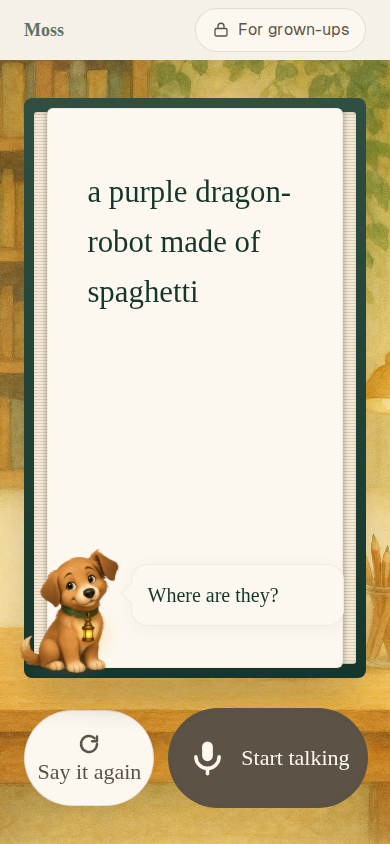
A small sentence, in their own words
There is a moment, when a child hears their own sentence read back, that no polished paragraph can buy. “The hen fed the pig.” “Noodle power.”
Many story generators take the child’s idea as a prompt and have the machine write the prose. Moss goes the other way. Your child provides the ideas and words. Moss helps turn them into a story.
What happens to what your child says
- Moss asks a question out loud, and your child answers by talking.
- Speech recognition turns the answer into text. That text, as Moss heard it, goes on the page. Each page’s words come from one of your child’s answers.
- If Moss misheard, or your child wants to say it another way, they can say that part again. The new words take the place of the old ones only once Moss has heard them; if the new try does not come through, the old words stay.
- When the book is finished, your child can hear it read aloud or read it themselves.
When Moss mishears
Speech recognition makes mistakes, and young children are hard to hear: small voices, new words, a sentence that turns around halfway. Sometimes Moss will hear a word that was not said, so we do not claim a perfect match between what your child says and what the page shows.
What we can tell you is how Moss handles it. The page shows what Moss heard, so a mistake is in plain sight and can be said again. If Moss could not hear an answer at all, nothing goes on the page and your child gets another try.
If you are sitting beside your child, watch the page while they tell the story. You will often know what they meant when Moss does not.
What that costs
Sometimes a page is one word. Sometimes a sentence is ungrammatical in the way a four-year-old is ungrammatical. We think that is worth more than fluency, and we are not going to pretend otherwise.
Where the pictures come in
The pictures are painted for the child’s words.
Keeping their words at home, with or without an app
- Write it down while they talk, before you tidy anything. Spelling can be sorted out later; the order of their ideas is the part you cannot get back.
- Read it back to them and ask, “Is that what you said?” If it is not, let them fix it.
- Ask open questions, like “What happened next?”, rather than offering words. A child who is handed a word will often take it.
- Record a voice memo too. A recording keeps what a page cannot: the pause, the giggle, the voice.
Keep reading
- See how Moss works.
- Compare: An honest kids’ reading app
- Compare: Moss Learning vs Ello
- Guide: An app where kids write their own book — by talking
- Guide: A story creator for kids who can’t type yet
Ready to try it? Join the free pilot below.
Moss Learning is opening to families soon — we'll hold your spot.